
The Desjardins side of the family originated in 17th-century France, and came to New France, now Canada, in 1665.
| Generation | Ancestor | Dates | Place / Significance |
| 1 | Me | 1967 – Living | British Columbia |
| 2 | My Mom | 1948 – Living | British Columbia |
| 3 | Cecilia Estelle Marie Deschner nee Johnston | 1928 – 1985 | British Columbia |
| 4 | Marie Louise Desjardins | 1907 – 1981 | My great-grandmother; daughter of Jean-Baptiste |
| 5 | Jean-Baptiste Desjardins | 1879 – 1946 | Born 2 Nov. 1879, English River, Ontario |
| 6 | Pierre Roy dit Desjardins | 1839 – 1916 | Jean-Baptiste’s father |
| 7 | Alexandre Roy dit Desjardins | 1805 – 1869 | Born Kamouraska; later died at Hebertville |
| 8 | Joseph Roy dit Desjardins | 1780 – 1864 | Born 13 Jan. 1780; Kamouraska |
| 9 | Alexandre Roy dit Desjardins | 1738 – 1813 | Born Kamouraska; militia officer and later political figure |
| 10 | Pierre Roy dit Desjardins | 1691 – 1771 | Born Ile d’Orleans; became established in Kamouraska |
| 11 | Pierre Roy dit Desjardins | c. 1669 – 1734 | Son of Antoine; early settler of Kamouraska |
| 12 | Antoine Roy dit Desjardins | 1635 – 1684 | Born in Joigny, France; immigrant to New France |
| 13 | Oliver Roy | 1604 – 1661 | Joigny, Burgundy, France |
Antoine Roy dit Desjardins (1635 – 1684)
From France to New France: The Beginning of the Roy dit Desjardins Family in Canada
For descendants of the Roy dit Desjardins family, the story begins not in Kamouraska or Rivière-Ouelle, but across the Atlantic in seventeenth-century France. Antoine Roy dit Desjardins belongs to the generation of pioneers who left the Old World and helped establish permanent French settlement in North America. Through him, the Roy dit Desjardins family became part of the founding population of Canada. [mesaieux.com], [genealogie.quebec]
A Childhood in France
Antoine Roy was born in France in the year 1635 (being baptized on 23 March of that year at Saint-Jean parish, Joigny), during the reign of King Louis XIII and shortly before the rise of Louis XIV, the famous Sun King. His parents were Olivier Roy (2 October 1604 – 6 December 1661) and Catherine Bauldard. At the time of his birth, the French colony in North America remained small and vulnerable. Québec had existed for only a few decades, and most of New France consisted of a handful of settlements along the St. Lawrence River. [geni.com], [genealogie.quebec]
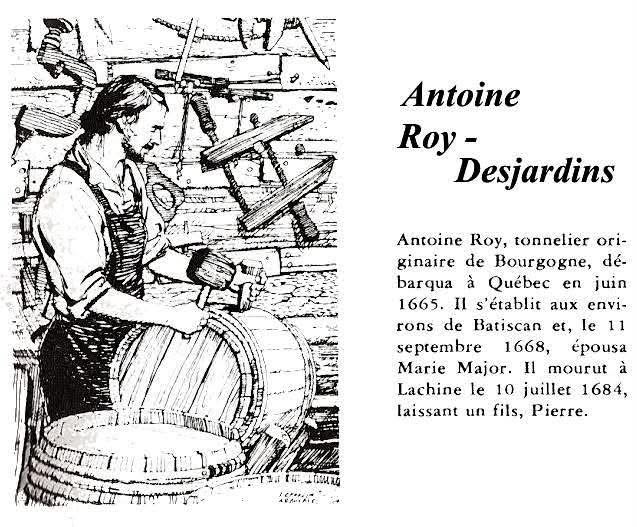
Antoine was a ‘maitre tonnelier’ (master cooper) like his father. Research in the Joigny parish records indicates that Antoine had apparently married in France to Catherine Byot, around 1657. Two sons are associated with that marriage: Jacques Roy, baptized 5 November 1658, and Edme Roy, baptized 13 March 1660. The French records appear to show the deaths/burials of two unnamed children of Olivier Roy in 1661, and these may be been Antoine’s children, although that identification is not absolutely certain.
Crossing the Atlantic
Like thousands of other young Frenchmen of his generation, Antoine would eventually be drawn by the opportunities offered in the colony. Land was scarce in many parts of France, while New France offered the possibility of becoming a landowner and establishing a family in a growing colony.
In 1665, Antoine came to New France with the Carignan-Salieres Regiment. This was part of a military expedition of roughly 1,200 men sent by King Louis XIV to New France to deal with the Iroquois raids that were strangling the colony.
The voyage itself was a remarkable undertaking. Crossing the Atlantic could take six to ten weeks, depending on weather and conditions. Passengers faced storms, disease, cramped quarters, and uncertainty. For those who survived the journey, arrival at Québec marked the beginning of an entirely new life.
The fleet assembled at La Rochelle and sailed in Spring 1665, ships arrived at Quebec in waves from late June through mid-August. The crossing itself normally ran six to eight weeks.
After landing, the troops were not kept in Quebec, They were pushed down the St. Lawrence and up the Richelieu River corridor to build and garrison the defensive line. Fort Richelieu (modern Sorel-Tracy), Fort Saint-Louis (Chambly), Fort Sainte-Therese, and later Fort Sainte-Anne. The winter of 1665-66 was spent in these garrisons, followed by Tracy’s campaigns against the Mohawk villages in September-October 1666. His company was stationed at Trois-Rivieres.
The colony Antoine encountered was rugged but full of opportunity. Dense forests lined the riverbanks. Settlements were small. The population of all New France numbered only a few thousand people.
Yet the foundations of French Canada were being laid.
Marriage and Family
After the 1666 campaign, the Iroquois threat eased with the 1667 peace treaty. That freed the king to pursue a bigger goal – populating the colony. Intendant Jean Talon had explicit instructions to convert the soldiers into settlers. So the regiment wasn’t simply disbanded, soldiers were actively recruited to remain.
Soldiers who stayed received seigneurial concessions along the St. Lawrence – in the Beaupre coast, Ile d’Orleans, and Richelieu valley areas. Land was the great prize for a man who had left France with little. Antoine obtained his concession at Batiscan in 1667.
Those who remained received their ‘conge’ (formal release) so they were not deserters – they left service legally with the status intact.
Talon added sweeteners for starting families, and the Filles du Roi program was bringing women over to marry precisely these men. On 11 September 1668, Antoine married Marie Major, at Notre-Dame de Quebec. She was a Fille du Roi, born in 1637 at Touques, Normandy, and the daughter of Jean Major and Marguerite Le Pele. This marriage would become one of the foundation stones of the Roy dit Desjardins family in North America. [mesaieux.com], [geni.com]
After the marriage, they returned to Batiscan. Their son, Pierre Roy dit Desjardins, was born to them in 1669. He became the progenitor of the extensive Canadian Roy dit Desjardins line; the later Roy dit Desjardins families of Quebec, including the branch that eventually reaches Kamouraska.
The 1681 census gives us a glimpse of Antoine’s circumstances. He was still identified as a Cooper, while also working his land. He was not a wealthy seigneur or prominent merchant. The census indicates that he had two cattle and about five arpents (4-1/4 acres cleared and planted) under cultivation.
Antoine possessed a skilled trade; that of a master cooper, which was in demand in a colony that shipped grain, flour, and fish. This put him ahead of a pure subsistence farmer – a cooper earned cash as well as feeding a family.
The couple had two cattle; possibly one for milking and the other one an ox for a plough. A small but genuine start – compared to households with fifteen head which marks real wealth.
They had enough land (4-14 acres) to feed a household with a little surplus grain to sell or barter. Typical amount for a settler about a decade into clearing his land – modest but viable.
All of this to say that Antoine was a tradesman-habitant, established, respectable, not rich – squarely in the middle tier of New France’s society.
The final years of Antoine’s life became considerably more difficult. By the early 1680’s he was in financial trouble. A creditor named Michel Lecourt pursued him for debts. The surviving legal material indicates that Antoine was working as a cooper and that there were disputes concerning money he owed.
By 1684 Antoine had moved into the Montreal area and was lodging with Julien Talua dit Vendamont.
This is where his life took its tragic turn.
Life Along the St. Lawrence
Antoine’s adult life unfolded almost entirely along the St. Lawrence River.
In the seventeenth century the river served as:
- the colony’s highway,
- the principal trade route,
- the link between settlements,
- and the primary means of communication.
There were few roads. Travel was normally by canoe, bateau, or sailing vessel. Settlements stretched along the shoreline in long, narrow farms designed to provide each family access to the river.
The pattern that would later define places such as Île d’Orléans, Rivière-Ouelle, and Kamouraska was already emerging during Antoine’s lifetime.
The Colony Expands
During Antoine’s years in New France, the colony experienced remarkable growth.
King Louis XIV made New France a royal colony in 1663, bringing greater support from France and encouraging immigration. The arrival of the Filles du Roi, the expansion of seigneurial settlements, and improved security allowed the population to increase steadily.
The colony that Antoine entered as a young man looked very different by the time of his death. New settlements appeared throughout the St. Lawrence Valley, agricultural production expanded, and French communities became more stable and prosperous.
Daily Life in Seventeenth-Century Canada
Life for Antoine required constant effort.
A typical year involved:
Spring
- clearing land,
- planting crops,
- repairing buildings damaged during winter.
Summer
- tending fields,
- fishing,
- transporting goods by river.
Autumn
- harvesting grain,
- preserving food,
- preparing livestock and fuel for winter.
Winter
- cutting firewood,
- hunting,
- maintaining tools,
- traveling by sled when conditions permitted.
The colony offered opportunity, but survival depended upon resilience, cooperation, and hard work.
Death in 1684
On 10 July 1684, Antoine was killed at Lachine by Julien Talua. The traditional account says Talue discovered Antoine in bed with his wife, Anne Godeby. Yet the actual legal record is considerably more complicated.
Talua claimed that he had discovered Antoine in an adulterous relationship with his wife. But Marie Major subsequently obtained testimony from people in Batiscan who described Antoine as an honest and respectable man and denied knowing of improper behaviour by him.
The case when through several stages of litigation. The Montreal court ultimately sentenced Talua to death. But then the Conseil souverain overturned the proceedings, finding that the Montreal case had been improperly conducted and ordering a new investigation.
Talua was subsequently released under conditions in December 1684.
My paternal Roy dit Desjardins line:
Burgundy/Joigny
Antoine Roy dit Desjardins
New France – Batiscan
Ile d’Orleans
Riviere-Ouelle
Kamouraska
Ontario
Augbiny, Manitoba
British Columbia
Ontario (me)
My family history here has quite a remarkable continuous story:
Antoine arrives from France in 1665 – Batiscan – Pierre established himself in the Kamouraska area in the 1690’s – the famly remains there for generations – Alexandre beccomes a militia officer and politician – Joseph is born there in 1780 – Alexandre 1805 – Pierre 1839 – Jean-Baptiste 1879 – Marie Louise 1907 – Cecelia Estelle 1938 – Mom 1948 – Eric 1967
This is roughly a 360-year Canadian family story with the same ancestral line.

Pierre Roy dit Desjardins (1669 – 1734)
A Pioneer Between Ile d’Orleans and the New Settlements of the Cote-du-Sud
For descendants of the Roy dit Desjardins family, Pierre Roy dit Desjardins stands at the frontier between the first generation born in New France and the expansion of settlement along the lower St. Lawrence. Born in 1669 and dying in 1734, he lived during a period when the colony was transforming from a handful of riverside settlements into a permanent French society stretching hundreds of kilometres along the St. Lawrence River. [genealogie.quebec], [geni.com]
Born Into a Young Country
Pierre Roy dit Desjardins was born in 1669, in Batiscan, Quebec on the north shore of the St. Lawrence just east of Trois Rivieres.
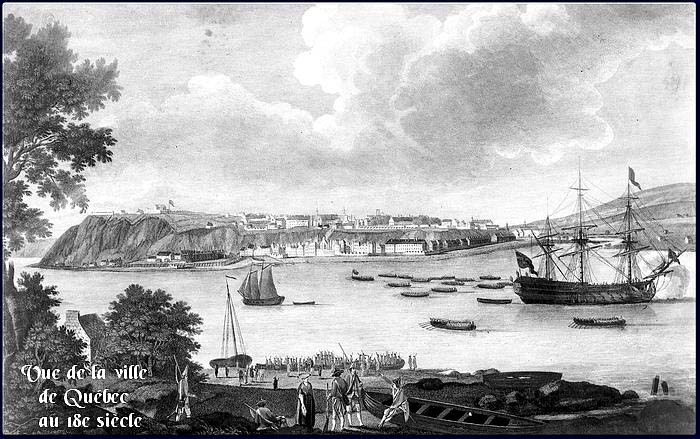
When Pierre was born, Québec City was barely sixty years old. Montréal was still a frontier settlement. Most French Canadians lived within a narrow band along the St. Lawrence River.
The river was everything.
It served as:
- the main highway,
- the trade route,
- the communication network,
- and the connection between families scattered across the colony.
Without the St. Lawrence, New France could not have existed.
Life Around Île d’Orléans
The Roy family’s early roots were connected to Île d’Orléans, one of the oldest and most important French settlements in North America. The island supplied food to Québec and became known as a cradle of French Canadian families.
Life there revolved around:
- farming,
- fishing,
- livestock,
- parish life,
- and seasonal river travel.
The landscape Pierre knew would have been remarkably familiar to a modern visitor: long narrow farms, church steeples visible above the fields, and the broad St. Lawrence dominating every horizon.
Moving Toward New Opportunities
After his father’s murder, on 10 Jul 1684 in Lachine, Pierre and his mother moved to Québec City where he worked as a cooper (a maker or repairer of casks and barrels).
By Pierre’s adulthood, population growth was creating pressure on established settlements near Québec. Sons needed farms of their own, and families increasingly looked eastward for available land.
During this period settlements expanded along the Côte-du-Sud, including:
- Rivière-Ouelle,
- Kamouraska,
- Saint-Roch-des-Aulnaies,
- L’Islet,
- and neighboring seigneuries. [histoire-d…-quebec.ca], [histoire-d…-quebec.ca]
Like many colonial families, the Roy dit Desjardins family followed this movement. What today appears to be a considerable distance was then a natural migration route by river.
A boat launching from the Québec region could move steadily eastward along the St. Lawrence, stopping at parish after parish before reaching Rivière-Ouelle or Kamouraska.
Building a Family in New France
Pierre married and established himself as a habitant during a period of rapid growth in the colony.
Pierre Le Roy entered into a marriage contract with Marie Anne Martin on 29 January 1691 in Québec (Quebec City), New France.
Pierre Leroy, aged 22 per the record, married Marie Anne Martin, aged 18 per the record, daughter of Joachim Martin and Anne Charlotte Petit, on 12 Feb 1691 in Saint-Pierre, Île d’Orléans, in the presence of known witnesses M. François Sauvée Bourgeois of Québec, Jean Bouchard of Orval, Paul Bouchard, and Jean Guyonne, the celebrant priest was Tremblay, curé.[3][4] They moved to her home parish of Saint-Pierre, Île d’Orléans where he continued to work as a cooper.
On 24 Jan 1695 Pierre and Marie received a gift (of land probably) from Antoine Juchereau. At the time they were living in the Comté of St-Laurent (île d’Orleans) at St-Pierre. On 7 Oct 1696 Pierre received a land grant in Kamouraska from Charles Aubert de la Chenaye. The family left Saint-Pierre in 1697 and settled on their new land in Kamouraska where he spent the next thirty years working as a farmer. The second church of Kamouraska was built on land that the Roy family gave to the church. The location of the second church is marked by a cross about a mile northeast of the intersection of Rte. 51 and 2 in Saint-André.
Marie Anne passed away on 6 Feb 1709 being given the age of around 35 years per the record. Her burial was the 8th in Rivière-Ouelle.
Pierre Leroy, widower of Marie Anne Martin, married Angélique Autin, aged 20 per the record, daughter of François Autin and Marie Boucher, on 25 Nov 1710 in Notre-Dame-de-Liesse parish of Rivière-Ouelle, in the presence of known witnesses Jacques Gagnon, Joseph Migneau, Pierre Thiboutot, Jacques Thiboutot, and Jean de Lavoye, the celebrant priest was J. Bernard De Requeleyne, curé.[6] Angélique passed away after 1721.
Pierre Roy, aged 36 per the record, widower of Angélique Autin, married Marie Delugré, aged 34 per the record, daughter of Jacques Delugré and Catherine Barbot, on 30 Oct 1727 in La-Purification-de-la-Bienheureuse-Vierge-Marie parish of Repentigny, in the presence of known witnesses Antoine Gabriel Martin, Jean Lamard, Nicolas Hébert, and François Janel, the celebrant priest was La Jemerais, missionary, and De Lagoudalie, who gave dispensation from the three banns.
Through these three women, Pierre fathered about twenty children! NHL player and coach Patrick Roy and Alphonse Desjardins, founder of the Caisse Populaire, are descendants bearing the Roy-Desjardins name. Other notable descendants include singers Céline Dion and Anne Murray.
The family became firmly rooted in the Kamouraska region, where future generations would remain for centuries. His son Alexandre Roy dit Desjardins, later a member of the Legislative Assembly of Lower Canada, was born in Kamouraska in 1738. [wikitree.com], [genealogie.quebec]
For Pierre, success would not have been measured by political influence but rather by:
- acquiring land,
- raising a family,
- maintaining productive farms,
- and ensuring that children survived to adulthood.
In eighteenth-century New France, these were significant accomplishments.
Daily Life Along the St. Lawrence
Pierre’s daily routine would have been demanding.
The year followed the agricultural cycle:
Spring
- clearing fields,
- planting grain,
- repairing fences damaged by winter.
Summer
- tending crops,
- cutting hay,
- fishing and transporting supplies.
Autumn
- harvest,
- storing food,
- preparing livestock for winter.
Winter
- wood cutting,
- sled travel,
- parish gatherings,
- and work inside the family home.
The farm was largely self-sufficient. Most necessities were produced locally. River commerce provided access to goods that could not be manufactured on the farm.
Witness to a Changing World
Pierre lived during a period when New France grew from a small colony into a mature society.
When he was born:
- the colony remained vulnerable,
- Indigenous alliances were essential,
- warfare was common.
By the time of his death:
- parish networks stretched across the St. Lawrence Valley,
- agricultural production had expanded,
- and communities such as Rivière-Ouelle and Kamouraska were firmly established. [histoire-d…-quebec.ca], [histoire-d…-quebec.ca]
In 1725, for example, Rivière-Ouelle already counted approximately thirty-one houses in addition to a manor and presbytery, reflecting the steady growth of the region during Pierre’s lifetime. [histoire-d…-quebec.ca], [histoire-d…-quebec.ca]
A Patriarch of the Roy dit Desjardins Family
Today, Pierre’s importance lies largely in the generations that followed him.
His descendants spread throughout:
- Kamouraska,
- Rivière-Ouelle,
- Saint-Pascal,
- La Pocatière,
- Trois-Pistoles,
- and eventually much of Quebec. [wikitree.com], [mesaieux.com]
Their names appear repeatedly in parish registers, notarial records, land transactions, and local history.
Through them, Pierre became an ancestor of thousands of Canadians.
Death in 1734
Pierre Roy dit Desjardin passed away on 29 Apr 1734 being given the age of around 50 years per the record. His burial was the 30th in Repentigny, in the presence of known witnesses Jean Baptiste Toins and Charles Goulet, the officiating priest was De Senclaves.
He did not live to see the British Conquest, the American Revolution, or the rise of his son Alexandre as a community leader. Yet his generation laid the groundwork for all of those later chapters.
The farms established along the St. Lawrence, the parish communities they helped build, and the family networks they created endured long after their deaths.
Pierre Roy dit Desjardins (1691 – 1771)
From Ile d’Orleans to the Shores of Kamouraska
Few men lived through as much change in early Canada as Pierre Roy dit Desjardins. Born in 1691 during the height of New France and dying in 1771 under British rule, his life bridged two empires and helped establish a family whose descendants would spread throughout Kamouraska, Rivière-Ouelle, and eastern Quebec. [genealogie.quebec], [geni.com]
A Birth in the Era of New France
Pierre Roy dit Desjardins was born in 1691, the son of Pierre Roy dit Desjardins (1669-) and Marie-Anne Martin. His grandparents belonged to some of the earliest generations of French settlers in Canada. The family’s roots connected them to the old settlements of the St. Lawrence Valley, including Île d’Orléans, one of the most important centres of French settlement in North America. [genealogie.quebec], [geni.com]
When Pierre was born, New France was still a fragile colony. The population of the entire colony numbered only a few tens of thousands. The St. Lawrence River was the colony’s lifeline, connecting scattered settlements from Québec to Montréal and beyond. Every aspect of life depended on the river. Travel, trade, communication, and migration all moved along its waters. [histoire-d…-quebec.ca], [histoire-d…-quebec.ca]
The Movement Eastward
Like many French-Canadian families, the Roy dit Desjardins family gradually expanded eastward in search of land for growing families.
During the late seventeenth and early eighteenth centuries, settlement spread beyond the older parishes surrounding Québec City. Families moved toward the Côte-du-Sud, settling places such as L’Islet, Saint-Roch-des-Aulnaies, Rivière-Ouelle, and Kamouraska. These new seigneuries offered fertile land and access to the river. [histoire-d…-quebec.ca], [histoire-d…-quebec.ca]
For Pierre and his generation, Kamouraska represented opportunity. Riverfront farms could support large families, and transportation by boat made it possible to remain connected with relatives elsewhere along the St. Lawrence.
Life as a Habitant
Most of Pierre’s life would have resembled that of thousands of other habitants.
His days revolved around:
- clearing land,
- cultivating wheat and oats,
- raising livestock,
- maintaining fences and buildings,
- participating in parish life,
- and helping neighbors during harvests and seasonal work.
The parish church stood at the center of community life. Baptisms, marriages, funerals, and feast days tied families together and created the records that genealogists still rely upon today. [histoire-d…-quebec.ca], [histoire-d…-quebec.ca]
Travel over land remained difficult. As a result, Pierre’s world was measured largely by the river. A trip from Kamouraska to Rivière-Ouelle or Québec City was often easier by water than by road.
Building a Family Legacy
One of Pierre’s most important contributions was not political office or military achievement, but the establishment of a family line that flourished across the Côte-du-Sud.
His son Alexandre Roy dit Desjardins was born in Kamouraska in 1738 and would later become a legislator in Lower Canada and a militia captain. Through Alexandre and his siblings, the Roy dit Desjardins family became firmly rooted in the region. [wikitree.com], [en.wikipedia.org], [genealogie.quebec]
Over time, descendants spread into:
- Kamouraska,
- Rivière-Ouelle,
- Saint-Pascal,
- La Pocatière,
- Trois-Pistoles,
- and other communities along the lower St. Lawrence. [wikitree.com], [mesaieux.com]
The World Changes Around Him
Pierre spent most of his life as a subject of the King of France.
During his lifetime:
- New France grew rapidly.
- New settlements appeared along the river.
- Parish populations expanded.
- Agricultural production increased throughout the colony.
Then came war.
The Seven Years’ War transformed Canada. In 1759 the British captured Québec. By 1760 French military resistance had largely ended, and in 1763 France formally ceded Canada to Great Britain. [en.wikipedia.org]
Pierre was already in his seventies when these events occurred.
Imagine the change. A man born during the reign of Louis XIV, raised entirely within French Canada, suddenly found himself living in a British colony without ever moving from his farm.
Yet daily life remained surprisingly familiar. The church remained in place. Farms continued to operate. Families still planted and harvested according to the seasons. The language of the home remained French.
Kamouraska in Pierre’s Time
The Kamouraska that Pierre knew was very different from today.
Instead of roads crowded with automobiles, there were shoreline paths and river vessels.
Instead of bustling towns, there were clusters of farmhouses stretching along long narrow concession lots.
Across the river stood the mountains of Charlevoix, as visible then as they are today. Fishermen worked local waters. Coastal vessels connected settlements. Church bells marked the rhythm of community life.
The landscape that modern visitors admire in Kamouraska was already taking shape during Pierre’s lifetime.
Final Years and Death
Pierre Roy dit Desjardins lived long enough to see the beginning of British rule in Canada and the emergence of a new generation of Roy descendants.
He died in 1771, only eight years after the formal transfer of Canada from France to Britain. [genealogie.quebec]
By the time of his death:
- the Roy dit Desjardins family was firmly established in Kamouraska,
- his children had begun raising families of their own,
- and the foundations had been laid for generations of descendants throughout eastern Quebec. [wikitree.com], [genealogie.quebec]
Alexandre Roy dit Desjardins (1738 – 1813)
Alexandre Roy dit Desjardins was born on 14 January 1738 at Kamouraska, then part of New France. He was the son of Pierre Roy dit Desjardins and Marie-Anne Bouchard, members of families that had already become established along the Côte-du-Sud. He was baptized the same day, a common practice in eighteenth-century Canada due to concerns about infant mortality.
Childhood in New France (1738 – 1754)
When Alexandre was born, Kamouraska was a small agricultural parish facing the St. Lawrence River. The settlements of Kamouraska, Rivière-Ouelle, Saint-Roch-des-Aulnaies, and L’Islet were tied together more by water than by roads. Travel was done primarily by canoe, sailing vessel, or winter routes across frozen rivers and bays.
Alexandre spent his youth during a period of relative prosperity in New France. Families such as the Roy dit Desjardins farmed narrow riverfront lots established under the seigneurial system. Daily life revolved around agriculture, parish life, and seasonal work connected to the river.
The Seven Years’ War (1754 – 1763)
Alexandre reached adulthood during one of the most dramatic periods in Canadian history.
Between 1754 and 1763, Britain and France fought the Seven Years’ War. During Alexandre’s late teens and early twenties, militia service became a reality for many young habitants along the St. Lawrence. Kamouraska and Rivière-Ouelle supplied men, food, and transportation to support the French colonial effort.
In 1759, when British forces captured Québec, Alexandre was twenty-one years old. He witnessed the transition from French rule to British rule. For residents of the Côte-du-Sud, daily life continued largely unchanged, but political authority shifted permanently from France to Great Britain.
Marriage at Riviere-Ouelle (1763)
Only months after the Treaty of Paris formally ended French rule in Canada, Alexandre married Marie-Josephe Plourde on 24 January 1763 at Rivière-Ouelle. The Plourde family was another well-established family of the region. [wikitree.com], [greenerpasture.com], [genealogie.quebec]
The marriage linked two long-established Côte-du-Sud families whose descendants would spread throughout Kamouraska and eastern Quebec.
Building a Family (1763 – 1790)
Alexandre and Marie-Josephe raised a large family, typical of French-Canadian households of the period. Records show numerous children born over the following decades. Several would carry the Roy dit Desjardins name into the nineteenth century and establish branches throughout the region. [wikitree.com]
During these decades Alexandre farmed in the Kamouraska area. Agriculture remained the economic foundation of life. Wheat, oats, livestock, and hay sustained local families, while river traffic connected them with Québec City.
The St. Lawrence remained central to everything:
- transportation,
- news,
- trade,
- communication,
- and contact with relatives in neighboring parishes.
The American Revolution Era (1775 – 1783)
When the American Revolution erupted, Alexandre was in his late thirties.
In 1775 American forces invaded Canada and advanced toward Québec. Although major fighting was concentrated elsewhere, the inhabitants of Kamouraska and Rivière-Ouelle watched events closely. Local militia organizations remained important and parish communities maintained loyalty to the British Crown, which had allowed French civil law and Catholic worship to continue under the Quebec Act of 1774.
For farming families like the Roy dit Desjardins, stability and protection of property were often more important than politics.
Community Leadership (1790 – 1804)
By the 1790s Alexandre had become one of the established men of the parish.
Kamouraska was growing in population and influence. New churches, schools, and local institutions were being developed, while agriculture and coastal trade expanded throughout the region.
His standing in the community eventually led to involvement in public affairs and politics.
Legislative Assembly of Lower Canada (1804 – 1808)
One of the most remarkable aspects of Alexandre’s life was his election to public office.
He represented Cornwallis County in the Legislative Assembly of Lower Canada from 1804 to 1808. This placed him among the early political leaders of French Canada following the Constitutional Act of 1791. [en.wikipedia.org]
For a farmer born under the French king in 1738, his political career reflected extraordinary changes:
- life under New France,
- British conquest,
- establishment of Lower Canada,
- and participation in a representative legislative assembly.
He chose not to seek re-election in 1808.
War of 1812
When war broke out between Britain and the United States in 1812, Alexandre was already in his seventies.
Despite his age, sources indicate that he served as a captain in the militia during the conflict. The militia system remained a fundamental part of local defense in Lower Canada, and respected community leaders often held officer positions. [en.wikipedia.org]
Although no major battles occurred in Kamouraska itself, residents feared American incursions and remained active in local defense preparations.
Death (October 1813)
Alexandre Roy dit Desjardins died at Kamouraska on 28 October 1813, at the age of seventy-five. He was buried in the parish where he had spent most of his life. [wikitree.com], [genealogie.quebec]
His wife, Marie-Josephe Plourde, survived him by several years, dying in 1817.
Joseph Roy dit Desjardins (1780 – 1873)
A Lifetime Along the St. Lawrence After the Conquest
Among the many descendants of the Roy dit Desjardins family, Joseph Amable Roy dit Desjardins witnessed one of the longest and most transformative periods in Quebec history. Born in 1780 and living into the 1870s, his life stretched from the era of sailing ships and British colonial rule to the beginnings of modern Canada. He was a grandson of Alexandre Roy dit Desjardins (1738-1813) and carried forward a family line that had already been established in Kamouraska for generations. [wikitree.com]
Born in Kamouraska
Joseph Amable Roy dit Desjardins was born on 13 January 1780 in Saint-Louis-de-Kamouraska. He was a son of Alexandre Roy dit Desjardins and Marie-Josephe Plourde, both members of long-established Côte-du-Sud families. [wikitree.com]
When Joseph was born, the British had controlled Canada for less than twenty years. The French language, Catholic faith, and seigneurial farming system remained firmly rooted in Kamouraska despite the political changes brought by the Conquest. [wikitree.com], [en.wikipedia.org]
The landscape he knew as a child would have been familiar to his grandfather and great-grandfather:
- Long ribbon farms fronting the St. Lawrence.
- Parish churches serving as the centre of community life.
- Small coastal vessels moving passengers and goods along the river.
- Close connections between Kamouraska, Rivière-Ouelle, La Pocatière, and neighboring parishes.
Growing Up During a New Political Era
Joseph’s childhood coincided with major changes in British North America.
During his early years:
- The American Revolution had recently ended.
- Loyalist settlements were developing elsewhere in British North America.
- The Constitutional Act of 1791 would soon create Lower Canada and establish an elected assembly.
While politicians debated constitutional matters, daily life in Kamouraska was still centered on farming, family, parish, and the river.
For young men such as Joseph, the path to adulthood remained much the same as it had been for generations before him: learn the farm, help the family, marry, and raise the next generation.
Marriage and Family
On 27 November 1804, Joseph married Modeste Pelletier in Kamouraska. The Pelletiers were another prominent family of the region. [wikitree.com]
Together they established a household during a period when the population of the Kamouraska area was expanding rapidly.
Their children included:
- Joseph Roy dit Desjardins
- Alexandre Roy dit Desjardins
- Marie Modeste Roy dit Desjardins
- Marie Léocadie Roy dit Desjardins
- Marie Anne Roy dit Desjardins
- Émelie Roy dit Desjardins
among others listed in family records. [wikitree.com]
Through these children, the Roy dit Desjardins name continued to spread throughout eastern Quebec.
Living Through the War of 1812
Joseph was thirty-two years old when war broke out between Britain and the United States in 1812.
His father, Alexandre, served as a militia captain during that conflict. [en.wikipedia.org]
Although no major battles occurred in Kamouraska itself, the people of the lower St. Lawrence followed the war closely. News traveled by ship and courier. Local militia units remained active, and communities prepared against the possibility of American incursions.
For Joseph, this period would have reinforced the importance of local family networks and community leadership that had characterized Kamouraska for generations.
The Changing World of the Ninteenth Century
Few members of the Roy dit Desjardins family witnessed as many changes as Joseph.
During his lifetime he saw:
- The decline of the seigneurial era.
- Steamships appear on the St. Lawrence.
- Increased settlement throughout eastern Quebec.
- The Rebellions of 1837-1838.
- The Union of Upper and Lower Canada.
- Confederation in 1867. [wikitree.com]
When Joseph was born, travel was still largely dependent on sail and seasonal roads.
By the time he died, railways were beginning to reshape transportation across Canada.
The world of his grandparents had been one of isolated river communities. The world of his grandchildren was increasingly interconnected.
Kamouraska During Joseph’s Lifetime
The Kamouraska that Joseph inhabited became known as one of the most picturesque and prosperous regions along the St. Lawrence.
The river remained central to life.
From the shoreline one could observe:
- Fishing boats.
- Coastal trading vessels.
- Steamships carrying passengers and freight.
- Seasonal ice roads in winter.
- The mountains of Charlevoix across the river.
Many features of the landscape recognizable today were already present during Joseph’s lifetime.
The Long Life of a Patriarch
Joseph lived an unusually long life for his era.
Born in 1780, he survived into his nineties, becoming a living link to earlier generations of New France descendants. [wikitree.com]
He would have personally known people born before the American Revolution and lived long enough to see the first years of the Dominion of Canada.
For a descendant of Antoine Roy dit Desjardins and the pioneer families of New France, that represents a remarkable historical span.
Death and Legacy
Joseph Amable Roy dit Desjardins died in Kamouraska in 1873, after more than nine decades of life. Sources connect his life entirely to the Kamouraska region where he had been born and raised. [wikitree.com]
His legacy was not political office or military fame. Instead, it was the continuation of a family line that had already endured for more than two centuries in Canada.
Alexandre Roy dit Desjardins – (1805 – 1869)
Alexandre was born in Saint-Louis, Kamouraska on the 3 September 1805. He was a ‘Cultivateur’ (farmer) in the region. His ancestry traces back through Kamouraska’s founding families, including the Roy, Plourde, Pelletier, Siriois, and Levesque lines – all prominent in the region’s early settlement.
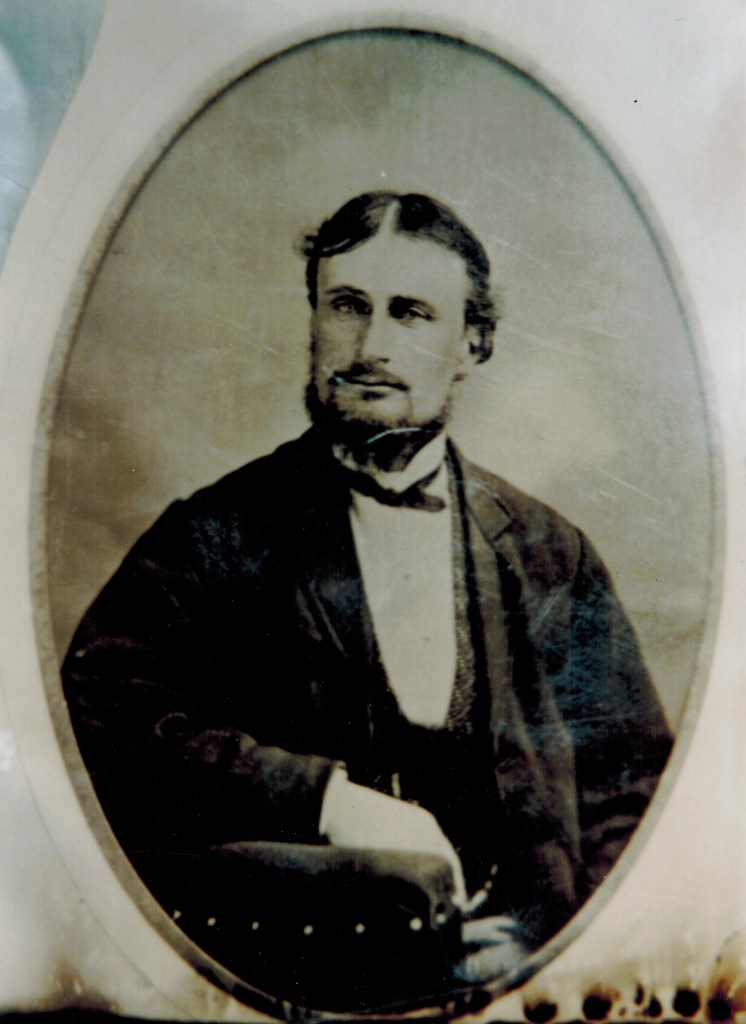
Alexandre married twice:
Marie-Osithe D’Anjou (1807 – 1825)
- Married: 18 January 1825, Riviere-Ouelle (Notre-Dame-de-Liesse)
- She died later that same year at age 18
Marie-Leocadie Gagnon (1808 – 1897)
- Married 24 July 1827, Saint-Jean-Port-Joli
This second marriage produced a large family typical of rural Quebec in the mid-19th century.
Across both marriages, Alexandre fathered at least 14 children. These children later married into families such as Caouette, Beaulieu, Robitaille, Fortin, and others – forming the backbone of Roy-Desjardins migration into Lac-Saint-Jean and Temiscouata.
Although born in Kamouraska, Alexandre died in Hébertville, Lac‑Saint‑Jean, one of the earliest colonized parishes in that region (founded 1849). His presence there by the 1860s places him among the first wave of settlers moving northward from the St. Lawrence valley into new agricultural lands.
This migration pattern is well‑documented for Kamouraska families: younger generations moved into Saguenay–Lac‑Saint‑Jean as land became scarce in the older seigneuries.
Alexandre died on 23 February 1869 at the age of 63. He was buried 25 February 1869 at Notre-Dame parish in Hebertville, Quebec.
Pierre Roy dit Desjardins – (1839 – 1916)
Pierre was born on 15 April 1839 at Saint-Louis, Kamouraska. He grew up to be a “Cultivateur” (farmer).
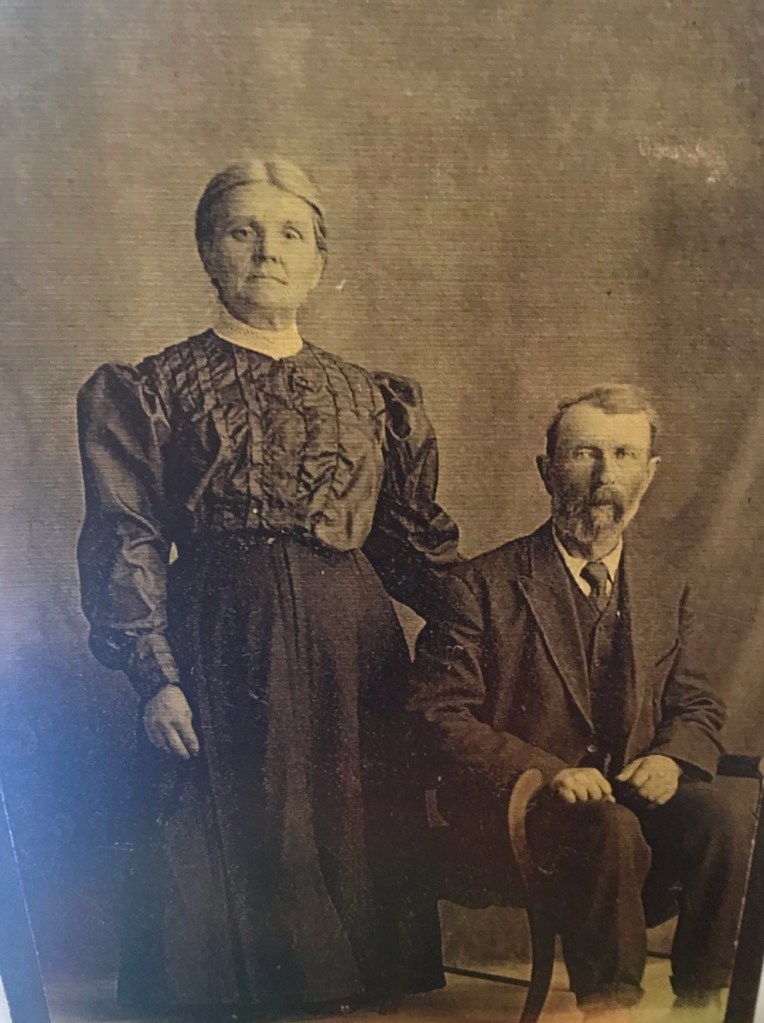
He married Marie-Lucie Robitaille on 4 February 1862 at Saint-Louis-de-Kamouraska.
They had twelve children the first being born in 1864 and the last in 1889.
It is suspected that economic opportunities brought Pierre and his family west from Quebec to English River, Ontario, where Pierre (possibly now known as Peter Roy) worked for the Canadian Pacific Railway under contract to Marks and Conmee.
A contemporary historical account identifies a man named Peter Roy as one of three men responsible for building the roadbed and hauling supplies on the Marks and Conmee CPR contract between English River and Eagle River in the summer of 1879. Because Pierre Roy dit Desjardins and his family were at English River at precisely this time– his son Jean-Baptiste being born there on 2 November 1879-it is a compelling possibility that Peter Roy was Pierre Roy dit Desjardins.
An 1891 Canadian Census identifies “Peter Roy” along with his family as being in Algoma at this time. His occupation listed is that of a “Stationery Engineer”.
Is is further supposed that after completion of this railway line (or end of contract) they found themselves in Manitoba and settling there for a time. This is where my great-great grandfather met his soon to be wife, and my great-grandmother, Marie Louise, was born to them in Aubigny, Manitoba in 1907.
Jean-Baptiste Desjardins (1879 – 1946)
Jean-Baptiste was born at English River, Ontario 11 February 1879. He was baptized 21 March 1879 at Port Arthur (amalgamated into the northern part of what is now Thunder Bay in 1970). No parish priest in English River so they travelled 188 kms to Port Arthur for the baptism!
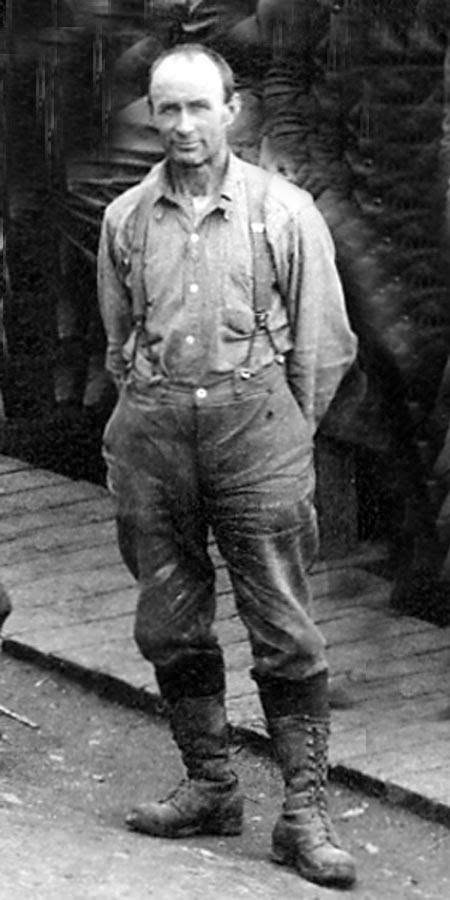
According to census data, by 1881 the family was living in Selkirk, Manitoba
Jean-Baptiste’s older brother, Adelard Roy dit Desjardins (1869 – 1914), also ended up in Prince Rupert. He died there on 18 October 1914, aged 45, and was buried in Prince Rupert. This supposes that Jean-Baptiste moved to BC on account of his brother’s experiences there in the area.
Jean-Baptiste married Marie Odelide Pelland and they had at least ten children, including:
- Marie Louise Desjardins (1907 – 1981)
What brought Jean-Baptiste from Manitoba all the way to British Columbia with his family to ultimately settle in Terrace, BC?
There were many enticing industries offering strong employment opportunities:
- port/shipping work
- railway employment
- fishing or cannery work
- mining
- construction
- lumber
Jean-Baptiste worked in the mining and logging industries, and during World War II he served as a lookout on Thornhill Mountain.
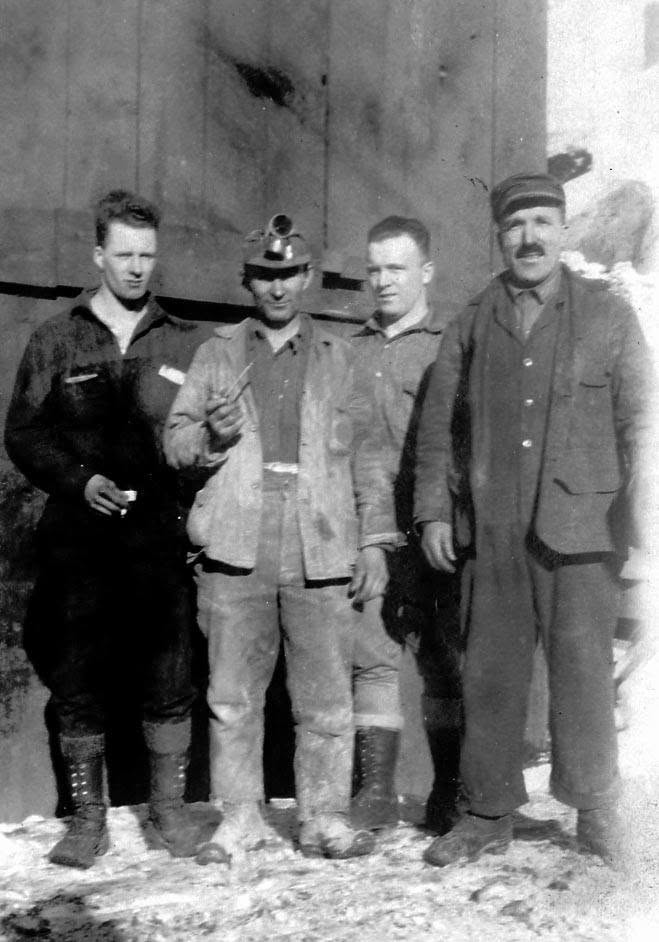
Jean-Baptiste died of cancer at Prince Rupert while in hospital on the 7th of March 1946 at the age of sixty-seven. A life-long smoker, his last wish was that all his sons-in-law would quit smoking.
Marie Louise Desjardins (1907 – 1981)
Great-grandmother
Cecilia Estelle Marie Johnston (1928 – 1985)
Grandmother


Leave a Reply