Tom Dunn’s Pipe Smokers Ephemeris Summer 1981 issue contained a letter written to Tom from R.D. (David) Field, who had recently toured the Dunhill factory in England. In his letter, David provided some interesting information on the use of Dunhill’s “OD” stamping and numbering, along with some terrific information on sources of briar, and qualities of the same.
I have reproduced that letter here for you to read for those interested.
I just returned from London where I attended Dunhill’s Principal Pipe Dealers World Conference. The two hundred or so guests involved (from as far away as Japan) were treated to an exceptionally well organized event which, in my opinion, reflects the attitude of the Dunhill group in promoting quality no matter the expense.
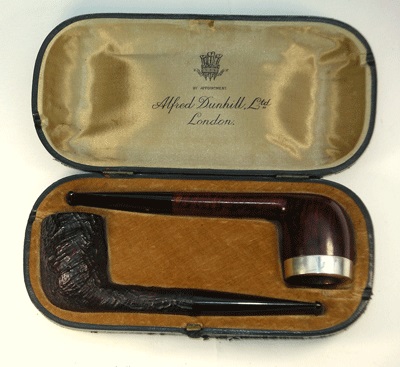
We were given a complete tour of the Dunhill pipe factory (which I had toured on my own this past April), the Parker-Hardcastle pipe factory, and the Dunhill tobacco works. There were also seminars with the organization’s top technical people in the pipe and tobacco fields where, again in my opinion, truthful answers were given to difficult questions instead of the corporate cover-up that one might have expected. We also had a chance to meet the President of the firm, Ms. Mary Dunhill and the Chairman, Mr. Richard Dunhill. Mr. Dunhill has, by the way, an intense interest in the firm’s past products. I found this out by meeting with the curator of the Dunhill Museum in order to show him two unsmoked “inner tubes” I had unearthed — a 1920 Bruyere 99 army mount and a 1923 Bruyere H.W. R/7. The curator asked if he could keep these two pipes overnight in order that he could show them to Mr. Dunhill who, he assured me, would surely want to examine them.
At the final dinner the guest of honor was Sir Harold Wilson, a very droll wit, who of course spoke on the subject of “pipe smoking”.
As for the factual information I obtained during and after the conference (for I did a lot of digging after the conference was over – speaking with some of the Duke Street shop staff who had been employed there for 20-40 years, two of the corporate staff, and two staff of Dunhill Pipes Ltd). I first want to correct a misconception that I inadvertently caused in describing my visit of last April to Dunhill Pipes Ltd. Dunhill is not using briar 10-20 years old in making its pipes. The average age of the briar used is 50-80 years. The size of the burls being used is quite small, and if this size burl had been harvested in the 1920’s-50’s it would have been 10-20 years old. The briar harvested today is being taken from places where it is much harder for it to survive; therefore it does not grow as large as burls harvested in the 1920’s-50’s.
Besides being smaller the burls taken today have tighter grain, are lighter in weight, and have more flaws. The grain is generally tighter now because the briar can not grow as large, year for year, as growing conditions are not as good where the wood is now harvested as they were with wood from the 1920’s-50’s. Because the briar has to struggle more to survive it grows much more slowly and the interior of the burl is tighter. The poor growing conditions, which are actually very beneficial when the wood is to be used for pipes, also cause the burl to take in more sand specks, dirt, etc. which in turn makes for more flaws. The 50-80 year old briar being used today is at least the equal of and may be superior to the 60-100 year old wood used in the 1920’s-50’s.
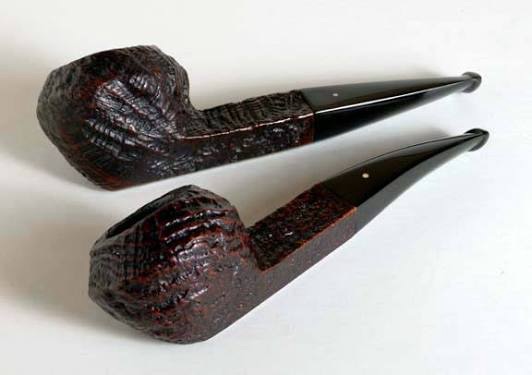
Some will undoubtably question the sandblasted Dunhills of today in comparison with those of previous years and will conclude that the wood of yesterday was far better because of the deep sandblasted surface it produced. This conclusion, I believe, is erroneous. The briar used for all “shells” came from Algeria until the early 1960’s. This briar was a softer wood than that of other localities around the Mediterranean and the soft parts of the turned bowl literally fell away during sandblasting. Sardinian briar was used exclusively for “tanshells” from their inception in 1954 until the early 1960’s While the surface blast was not as deep as that of the “shells” because the wood was generally harder it was not as hard as that found in other locations. In the early 1960’s the Algerian briar supply greatly diminished; the Sardinian supply diminished in the mid-to-late 1960’s. Dunhill now had to use all varieties of briar for all its finishes and this precluded the deep sandblasted surface when other, harder, varieties were used. The harder varieties of briar have fewer soft spots and so much less of the surface falls away under the sand-jet. If such a bowl is sandblasted for a longer period in order to achieve a deeper blast the hard grain goes the way of the soft and the bowl loses shape.
Deep sandblasts are still commonplace when Algerian briar is used, but the harvest of Algerian is quite small today.
If in choosing a pipe one wants an old piece of briar, there is a prime axiom to remember: tight grain (whether cross-cut, birdseye, or straight grain) equals old wood. There is no way to artificially tighten grain.
A word about the 800 series pipes: while in London I had the privilege to view the original drawings of all the Dunhill shapes dating back to the 1910 and the Masons Yard works. This included the 800 series — the OD’s (Oversize Dunhill), ODA’s (American), ODB’s (Bahamas – a British free port at the time and not British as generally thought), ODC’s (Canadian). There are many more pipes in the 800 series than is commonly believed. The new shape #’s I have uncovered are the 802, 803, 804 (odd bents), 805 (don’t remember this shape), 831, 833 (Danish flat-bottom bents), 861, 865, 866 (square bowls).
For those interested in the nonclemanture of the 1920’s-30’s shapes I have information regarding the meaning of the #’s after the shape #’s (as in R/7, FET/24, 41/21). These #’s have to do with the size of the inner tube to be inserted into the pipe.
Tom, I’m still selling new and used Dunhills and getting more into the collector market. At the moment in new wood I have an ODA 844 (poker) which is also a two star straight grain (the only one in existence to my knowledge), and an ODA 857 (bent apple with spur) in a natural sandblast finish (again the only one known to exist) and a group of 9 unsmoked bruyeres and shells dating 1920 through 1926. In used wood I have a 1927 L.C. in perfect condition. These will be gone by the time your readers see this but I hope to acquire more of the same in future.
Best regards,
David


Leave a Reply